Updated: October 2026
Introduction
The legal framework for operating a shisha lounge in Australia is more complicated than simply opening a café, arranging waterpipe equipment, and providing an outdoor seating area.
Shisha, also known as hookah, nargile, or waterpipe smoking, has cultural associations with Middle Eastern, North African, and South Asian communities. However, businesses offering shisha services must comply with Australian tobacco legislation, smoke-free environment laws, and local business regulations.
Australia does not have one nationwide licence that automatically authorizes a shisha lounge to operate in every state.
Instead, businesses must consider federal tobacco rules alongside state, territory, and local council requirements.
This guide explains how Australian shisha lounge laws affect indoor smoking, outdoor dining, hospitality premises, tobacco retailing, and venue compliance in 2026.
1. Are Shisha Lounges Legal in Australia?
Shisha lounges are not subject to a single nationwide prohibition based solely on being a shisha business.
However, this does not mean that every venue can lawfully offer waterpipe smoking.
The legality of an individual establishment depends on its location, physical layout, operating model, and compliance with applicable legislation.
Understanding the Legal Framework
Three major regulatory areas are particularly important:
- Federal tobacco product legislation.
- State and territory smoke-free environment laws.
- Local business, planning, and hospitality requirements.
A business may also need to consider tobacco retail licensing, food business registration, building approvals, fire safety, and relevant workplace obligations.
Permission to operate a café does not automatically authorize shisha smoking on the premises.
2. Indoor Shisha Smoking Restrictions
Australian smoke-free laws generally prohibit smoking in enclosed public places, including restaurants, cafés, workplaces, and hospitality venues.
These restrictions also apply to waterpipe smoking.
Why Indoor Hookah Areas Are Restricted
Waterpipe smoking can produce substantial amounts of smoke containing nicotine, carbon monoxide, and other toxic substances.
The smoke can affect both customers and employees.
Australia’s smoke-free environment laws are intended to reduce involuntary exposure to second-hand smoke.
Does Ventilation Make Indoor Shisha Smoking Legal?
Installing air conditioning, extraction fans, or a mechanical ventilation system does not automatically create a legal exemption.
The legal definition of an enclosed area depends on the relevant jurisdiction’s legislation.
Businesses should not assume that improved ventilation permits smoking in an otherwise prohibited indoor location.
3. Shisha Lounge Laws in New South Wales
New South Wales has strict restrictions on smoking in commercial hospitality environments.
These rules are especially relevant to businesses researching shisha cafés in Sydney.
Commercial Outdoor Dining Areas
Under the Smoke-free Environment Act 2000, smoking is prohibited in commercial outdoor dining areas.
This includes waterpipe smoking.
NSW Health identifies shisha, hookah, nargile, argileh, and related forms of waterpipe smoking as covered by the restrictions.
Examples of prohibited smoking locations include:
- Commercial outdoor seated dining areas.
- Areas within four metres of seated dining areas at relevant hospitality venues.
- Areas within ten metres of food fair stalls.
- Enclosed public hospitality spaces.
Shisha and Food Service
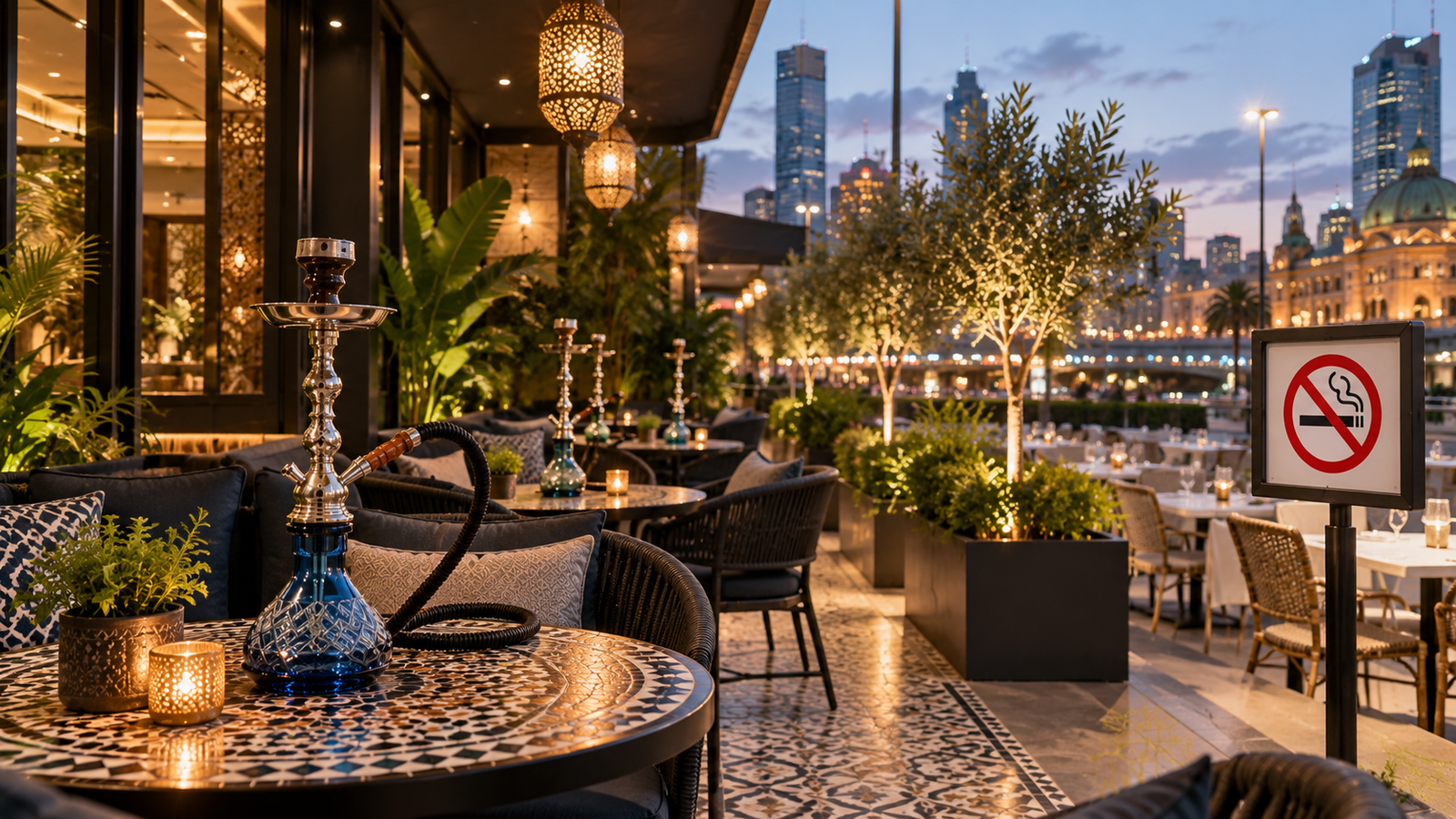
A business cannot assume that placing shisha tables outside a restaurant makes smoking lawful.
Where a space is classified as a commercial outdoor dining area, the smoking prohibition applies.
This creates an important distinction between a legally permissible smoking area and an ordinary outdoor dining terrace.
Enforcement and Penalties
NSW Health states that on-the-spot fines may apply to individuals who smoke in prohibited outdoor dining areas.
Business operators can also face substantial penalties for non-compliance.
Venue managers should review current penalty amounts and enforcement requirements before establishing operations.
4. Shisha Lounge Laws in Victoria
Victoria also regulates waterpipe smoking through its tobacco and smoke-free environment legislation.
These provisions are relevant to Melbourne hospitality businesses.
Outdoor Dining Restrictions
Smoking, including shisha tobacco smoking, is prohibited in commercial outdoor dining areas.
Covered spaces include restaurant terraces, footpath dining areas, courtyards, and other areas used for eating food.
Outdoor Drinking Areas
Victoria makes an important distinction between outdoor dining areas and outdoor drinking areas.
Smoking in an outdoor drinking area may be prohibited where the area is sufficiently enclosed or located close to an outdoor dining area.
For example, an outdoor drinking area within four metres of an outdoor dining area may be subject to restrictions unless the relevant separation requirements are met.
Businesses must assess the applicable roof, wall, and separation conditions.
Required Signage
Venues must display appropriate no-smoking signs in areas where smoking is prohibited.
Businesses should ensure staff understand the restrictions and prevent smoking in areas where it is unlawful.
5. Shisha Lounge Laws in Queensland
Queensland has its own comprehensive tobacco and smoking legislation.
The rules affect restaurants, cafés, licensed hospitality premises, and outdoor eating and drinking areas.
Indoor Hospitality Venues
Smoking and vaping are prohibited inside eating and drinking venues such as cafés, pubs, clubs, and restaurants.
These restrictions are also relevant to hookah smoking.
Outdoor Eating and Drinking Areas
Queensland prohibits smoking in commercial outdoor eating and drinking areas and generally within a five-metre buffer around these areas.
This is especially important for venues intending to combine waterpipe services with food or beverage consumption.
Smoking-Only Areas
Queensland law provides limited arrangements for appropriately designated smoking areas.
However, strict conditions apply.
For example, food or drink generally must not be served or consumed in smoking-only areas.
Designated outdoor smoking areas at certain liquor-licensed premises have separate requirements.
A business should not treat these provisions as unrestricted permission to operate a conventional shisha café.
6. Comparing Shisha Smoking Restrictions
The following table illustrates selected differences between three major Australian jurisdictions.
| Regulation | New South Wales | Victoria | Queensland |
|---|---|---|---|
| Indoor restaurant smoking | Prohibited | Prohibited | Prohibited |
| Outdoor commercial dining smoking | Prohibited | Prohibited | Prohibited |
| Waterpipe smoking covered | Yes | Yes | Yes |
| Restrictions near dining areas | Four-metre rules in specified settings | Four-metre separation rules in specified settings | Five-metre buffers in specified settings |
| Designated smoking arrangements | Location-dependent | Location-dependent | Limited arrangements subject to conditions |
| Hospitality compliance | State and local requirements | State and local requirements | State and local requirements |
This comparison is not a complete statement of all relevant laws. Other states and territories must be assessed separately.
7. Tobacco Retailing and Shisha Lounge Operations
Businesses offering tobacco-containing shisha may also trigger tobacco retail requirements.
Retail Licences
Tobacco retail licensing rules vary by state and territory.
A venue should determine whether its business activities constitute tobacco retailing and which permissions are required.
Product Packaging
Australia regulates tobacco products under federal legislation, including standardized packaging and health-warning requirements.
Shisha tobacco is recognized as a tobacco product under the applicable framework.
Advertising Restrictions
Australia imposes extensive restrictions on tobacco advertising and promotion.
Business websites, signs, social media communications, and promotional materials may require particular care.
Operators should not assume that advertising a shisha lounge also permits unrestricted promotion of tobacco products.
8. Business Planning Considerations
For those researching the Australian hospitality sector, several operational questions should be answered before committing to a venue.
Property and Planning Approval
Local councils may impose requirements concerning the permitted use of premises, building modifications, noise, outdoor seating, and other activities.
Fire and Workplace Safety
Waterpipe operations can involve charcoal heating and the associated risks of burns, fire, carbon monoxide exposure, and smoke.
Relevant workplace safety responsibilities should be assessed.
Food and Beverage Service
Where food or beverages are supplied, the business may also need to meet food safety and hospitality licensing requirements.
The interaction between food service and smoke-free laws is particularly important.
Staff Training
Employees should understand smoking restrictions, customer safety, applicable age restrictions, and the venue’s compliance procedures.
9. Are Tobacco-Free Shisha Products Exempt?
Some products marketed as herbal or tobacco-free shisha do not contain tobacco or nicotine.
However, businesses should not assume these products are automatically exempt from smoke-free environment laws.
In New South Wales, for example, waterpipe smoking restrictions also apply to relevant non-tobacco smoking products.
The absence of nicotine does not eliminate risks from carbon monoxide and other substances produced during combustion.
Operators should check the legal treatment of the exact product and method of use.
10. Common Misunderstandings About Australian Shisha Lounges
Myth: Outdoor Seating Always Makes Shisha Legal
Outdoor dining areas can be subject to strict smoking prohibitions.
Myth: A Café Licence Is Enough
Business registration and food service permission do not automatically authorize tobacco retailing or waterpipe smoking.
Myth: A Powerful Ventilation System Creates an Exemption
Ventilation does not independently override smoke-free legislation.
Myth: Herbal Shisha Is Unregulated
Smoke-free laws can apply to non-tobacco waterpipe products.
Myth: All Australian States Have the Same Rules
State and territory requirements differ, particularly concerning outdoor areas, designated smoking spaces, retail licensing, and enforcement.
Frequently Asked Questions
1. Are shisha lounges legal in Australia?
A shisha lounge is not automatically illegal simply because of its business name. However, operating a venue where customers smoke waterpipes requires compliance with strict state, territory, and local laws. Many ordinary indoor and outdoor hospitality settings prohibit smoking.
2. Can you smoke shisha inside a café in Sydney?
No. NSW smoke-free laws prohibit smoking in enclosed public hospitality spaces, including cafés and restaurants. Waterpipe smoking is covered by these restrictions.
3. Can Melbourne shisha lounges operate outdoors?
Outdoor operation does not automatically establish legality. Victoria prohibits smoking in commercial outdoor dining areas and applies additional restrictions to certain outdoor drinking areas.
4. Can a Queensland shisha café serve food and offer smoking in the same area?
Queensland has restrictions on smoking in and around eating and drinking areas. Limited designated smoking arrangements exist, but they are subject to conditions that restrict food and beverage service.
5. Are herbal shisha products allowed in smoke-free areas?
Not necessarily. Smoke-free legislation may cover smoking products even when they do not contain tobacco or nicotine.
6. Do shisha lounges need a tobacco licence?
Requirements depend on the state or territory and the nature of the business activities. Operators should verify applicable tobacco retail licensing obligations.
7. Is ventilation enough to make indoor hookah smoking legal?
No. Installing ventilation equipment does not automatically exempt a venue from smoking restrictions.
8. What should businesses check before opening a shisha lounge?
Businesses should assess local smoke-free rules, property and planning approvals, tobacco retail licensing, food service requirements, fire safety, staff safety, and relevant advertising restrictions.
Conclusion
Understanding shisha lounge laws in Australia requires careful consideration of the different rules governing hospitality venues, tobacco products, and smoke-free environments.
New South Wales, Victoria, and Queensland all impose significant restrictions on waterpipe smoking in commercial dining areas, but their detailed requirements differ.
For operators and industry researchers, it is important to distinguish between general permission to operate a hospitality business and the legal ability to provide shisha smoking services.
Businesses should consult the relevant state health authority, local council, and qualified legal advisers before making operational decisions.
Disclaimer: This article provides general industry information and does not constitute legal, licensing, medical, or business compliance advice.
https://www.health.nsw.gov.au/tobacco/Pages/outdoor-dining.aspx?utm_source=chatgpt.com