
Updated: October 2026
Introduction
The United States has become an important center for scientific research, regulatory development, and laboratory analysis involving cannabis-derived chemical compounds.
From cannabidiol (CBD) and tetrahydrocannabinol (THC) to lesser-known cannabinoids such as cannabigerol (CBG) and cannabinol (CBN), researchers continue to investigate the chemistry, stability, biological activity, and analytical characteristics of compounds associated with the cannabis plant.
Understanding cannabis-derived chemicals in the USA requires more than identifying individual cannabinoids.
Businesses and researchers must also consider chemical composition, purity, analytical testing, quality documentation, product classification, and the differences between federal and state regulations.
In 2026, these considerations are particularly important because federal hemp legislation is approaching a significant change.
This article examines major cannabis-derived chemical compounds, their scientific characteristics, laboratory quality standards, and the evolving United States regulatory environment.
1. What Are Cannabis-Derived Chemicals?
Cannabis-derived chemicals are compounds naturally present in cannabis plants or obtained from cannabis-related materials.
The cannabis plant contains a complex mixture of chemical constituents, including cannabinoids, terpenes, flavonoids, and other naturally occurring substances.
These compounds differ in molecular structure, physical properties, chemical stability, and biological activity.
Main Chemical Categories
Cannabis chemistry can be broadly divided into several categories:
- Cannabinoids: Compounds such as THC, CBD, CBG, and CBN.
- Terpenes: Aromatic compounds including myrcene, limonene, and beta-caryophyllene.
- Flavonoids: Plant compounds associated with pigmentation and other biological functions.
- Other Plant Constituents: Lipids, waxes, pigments, and additional organic substances.
The relative composition of these chemicals varies with plant genetics, growing conditions, maturity, storage, and processing history.
2. Major Cannabinoids Found in Cannabis
Cannabinoids are among the most extensively studied chemical constituents of cannabis.
Cannabidiol (CBD)
Cannabidiol is a naturally occurring cannabinoid with the molecular formula C21H30O2.
CBD does not produce the characteristic intoxicating effects associated with delta-9 THC.
However, CBD is pharmacologically active and is not automatically risk-free.
The U.S. Food and Drug Administration has identified concerns involving liver injury, drug interactions, and other potential adverse effects.
A purified form of CBD is used in the FDA-approved prescription medication Epidiolex for certain seizure disorders.
Delta-9-Tetrahydrocannabinol (THC)
Delta-9 THC is the primary cannabinoid associated with the intoxicating effects of cannabis.
Like CBD, it has the molecular formula C21H30O2, but the compounds have different molecular structures.
This structural difference contributes to their different interactions with biological systems.
THC-containing materials are subject to important legal restrictions, and their status depends on classification, concentration, product form, and applicable law.
Cannabigerol (CBG)
Cannabigerol is another naturally occurring cannabinoid.
CBG has attracted scientific interest because of its relationship to cannabinoid biosynthesis and its distinct chemical characteristics.
However, research findings should not be interpreted as proof of established medical benefits.
Cannabinol (CBN)
Cannabinol is a cannabinoid associated with certain chemical changes occurring in THC-containing materials.
Its presence can be relevant to studies of product stability and chemical composition.
Claims about CBN’s therapeutic effectiveness require reliable clinical evidence and applicable regulatory authorization.
3. CBD vs. THC vs. CBG vs. CBN: Chemical Comparison
| Compound | Molecular Formula | Scientific Characteristic |
|---|---|---|
| CBD | C21H30O2 | Non-intoxicating cannabinoid with pharmacological activity |
| Delta-9 THC | C21H30O2 | Principal intoxicating cannabinoid |
| CBG | C21H32O2 | Naturally occurring cannabinoid associated with biosynthetic pathways |
| CBN | C21H26O2 | Cannabinoid associated with oxidative transformation processes |
Although these compounds are chemically related, they are not interchangeable.
Their molecular structures, pharmacological properties, analytical characteristics, and regulatory treatment differ.
4. Natural Cannabinoids and Chemically Modified Compounds
An important distinction in the American cannabis sector concerns naturally occurring cannabinoids and compounds produced or altered through chemical processes.
Naturally Occurring Cannabinoids
These compounds may be present in cannabis plant material at different concentrations.
Their relative abundance varies across plant varieties and environmental conditions.
Chemically Modified Cannabinoids
Some cannabinoid products contain substances produced through chemical modification rather than directly isolated from a plant.
These materials can raise additional concerns involving:
- Chemical identity.
- Unexpected impurities.
- Residual processing chemicals.
- Incomplete toxicological data.
- Product stability.
- Regulatory classification.
The chemical origin of a compound does not independently establish its safety or legality.
In the United States, the forthcoming federal hemp definition changes are especially relevant to cannabinoids synthesized or manufactured outside the cannabis plant.
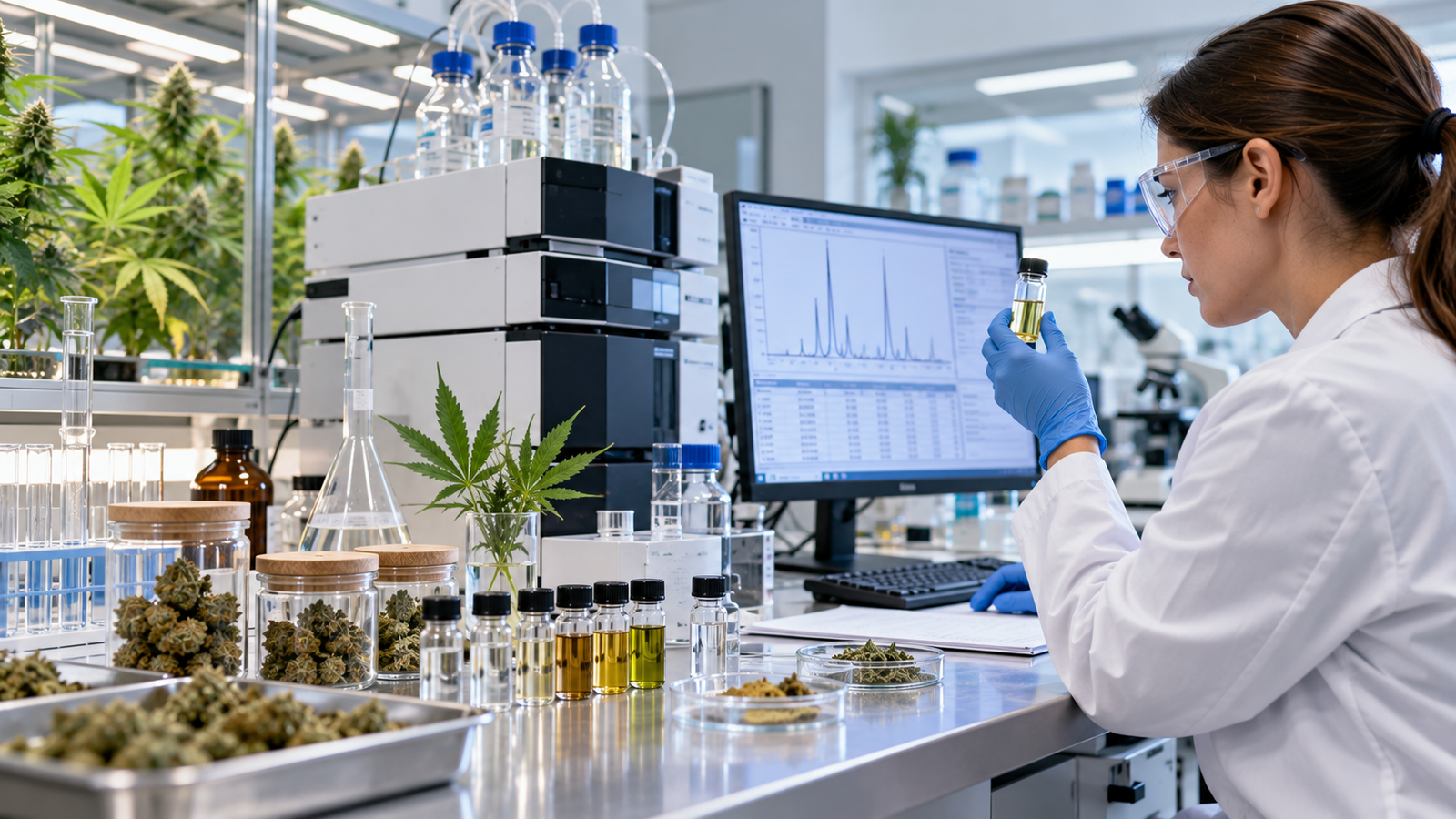
5. Laboratory Testing of Cannabis-Derived Chemicals
Laboratory analysis is essential for establishing the identity, composition, and quality of cannabis-derived materials.
High-Performance Liquid Chromatography (HPLC)
HPLC is commonly used to analyze cannabinoid profiles.
Depending on the validated method, laboratories may distinguish between cannabinoids and their acidic precursor forms.
This can be useful when assessing cannabinoid composition without relying solely on techniques involving elevated temperatures.
Gas Chromatography–Mass Spectrometry (GC-MS)
GC-MS is an analytical technique used for identifying and measuring suitable chemical constituents.
It is particularly useful in certain residual solvent, volatile compound, and contaminant analyses.
The suitability of the technique depends on the analyte and the validated method.
Inductively Coupled Plasma Mass Spectrometry (ICP-MS)
ICP-MS is widely used in elemental analysis.
For cannabis-derived materials, it may be applied to assess contamination involving metals such as lead, cadmium, arsenic, and mercury.
Microbiological and Pesticide Testing
Depending on the product and applicable standards, testing programs may also address microbiological contamination, pesticides, and other potentially hazardous substances.
A comprehensive laboratory program should reflect the intended application and applicable regulatory framework.
6. Certificates of Analysis and Quality Documentation
A Certificate of Analysis (COA) provides analytical information about a tested material or product.
For cannabis-derived chemicals, a COA may include:
- Product or sample identification.
- Laboratory name and contact information.
- Batch or lot number.
- Analytical methods.
- Cannabinoid composition.
- Contaminant testing results.
- Measurement units and reporting limits.
- Testing and report dates.
- Applicable specifications.
- Authorized laboratory review.
Why COAs Matter
A COA can support quality assessment and traceability.
However, a COA does not automatically establish that a product is safe, medically effective, approved by the FDA, or legally marketable.
Analytical findings must be interpreted alongside product specifications, applicable laws, and the quality system under which testing was performed.
Third-Party Testing
Independent laboratory testing can provide additional confidence when appropriately designed and conducted.
Businesses should consider laboratory competence, analytical method validation, and relevant accreditation, including ISO/IEC 17025 where applicable.
7. Cannabis and Hemp Regulations in the United States
The legal framework for cannabis-derived compounds includes federal statutes, FDA requirements, and state-level regulations.
The 2018 Farm Bill
The Agriculture Improvement Act of 2018 established a federal definition of hemp based on a delta-9 THC concentration of no more than 0.3% on a dry-weight basis.
The legislation distinguished qualifying hemp from marijuana under the federal Controlled Substances Act.
However, removing qualifying hemp from that definition did not eliminate FDA authority over foods, drugs, cosmetics, and other regulated products.
Federal Hemp Definition Changes in 2026
Legislation enacted on November 12, 2025, amended the statutory definition of hemp, with the changes scheduled to take effect on November 12, 2026.
The amended framework introduces a total tetrahydrocannabinols standard, including tetrahydrocannabinolic acid (THCA).
It also excludes certain intermediate and final hemp-derived cannabinoid products from the federal hemp definition.
Among the new provisions is a limit addressing final hemp-derived cannabinoid products containing more than 0.4 milligrams per container of combined total tetrahydrocannabinols and other specified cannabinoids with similar effects.
The legislation also addresses cannabinoids that cannot naturally occur in cannabis and certain cannabinoids synthesized or manufactured outside the plant.
These changes have potentially significant implications for the classification of cannabis-derived chemical materials.
The effective statutory language, subsequent implementation guidance, and applicable federal and state requirements should be reviewed before any business decision.
State-Level Regulations
State cannabis laws differ substantially.
Some states permit regulated adult-use cannabis markets, others provide medical cannabis programs, and some impose more restrictive requirements.
A product being permissible under a particular state framework does not automatically mean it can be lawfully marketed or transported across state lines.
8. FDA Oversight of Cannabis-Derived Products
The FDA regulates cannabis and cannabis-derived ingredients when they fall within its jurisdiction over drugs, food, dietary supplements, cosmetics, and other regulated categories.
Pharmaceutical Products
Cannabis-derived pharmaceutical products must meet applicable drug development and approval requirements.
Epidiolex is an example of an FDA-approved prescription drug containing purified CBD.
CBD in Foods and Dietary Supplements
The FDA has determined that CBD cannot lawfully be marketed as an ingredient in conventional foods or as a dietary supplement under the current federal framework.
Businesses should distinguish between products appearing in the marketplace and products that comply with federal requirements.
Cosmetics
Cannabis-derived ingredients used in cosmetics must comply with applicable safety, labelling, and other requirements.
Cosmetic products generally do not require FDA premarket approval, although specific exceptions and legal requirements apply.
Unsubstantiated Medical Claims
Marketing unapproved cannabis-derived products as treatments for diseases can violate federal law.
Scientific interest in a compound should not be presented as established therapeutic effectiveness.
9. Quality Risks in Cannabis-Derived Chemical Products
Chemical quality is a critical issue for researchers and regulatory authorities.
Potential concerns include:
- Inaccurate cannabinoid concentrations.
- Residual solvents.
- Pesticide contamination.
- Heavy metals.
- Microbiological contamination.
- Unexpected reaction byproducts.
- Chemical degradation during storage.
- Incomplete product documentation.
The FDA has reported discrepancies between labelled and measured CBD concentrations in some products.
This highlights the importance of reliable laboratory methods and quality assurance systems.
10. Future Directions in U.S. Cannabinoid Research
The scientific study of cannabis-derived chemicals continues to develop in several areas.
These include analytical chemistry, cannabinoid identification, toxicology, product stability, clinical research, and the characterization of impurities.
The regulatory environment is also evolving.
For researchers, manufacturers, and regulatory professionals, understanding the chemical properties of cannabinoids and the legal classification of their products remains essential.
Future progress will depend on well-designed research, transparent analytical methods, reliable quality documentation, and clear regulatory oversight.
Frequently Asked Questions
What are cannabis-derived chemicals?
Cannabis-derived chemicals are substances associated with cannabis plants, including cannabinoids, terpenes, flavonoids, and other organic compounds.
What is the difference between CBD and THC?
CBD and delta-9 THC share the same molecular formula but have different chemical structures and pharmacological effects. Delta-9 THC is intoxicating, whereas CBD does not produce the same characteristic intoxication.
What are CBG and CBN?
CBG and CBN are cannabinoids found in or associated with cannabis materials. They differ in chemical structure, formation, and biological characteristics.
How are cannabinoids analyzed in laboratories?
Validated techniques can include HPLC, GC-MS, and other chromatography or spectroscopy-based analytical methods.
What is a cannabis Certificate of Analysis?
A COA is a laboratory report presenting analytical results for a particular sample or batch. It may include cannabinoid concentrations and contaminant testing.
Are all hemp-derived chemicals legal in the United States?
No. Federal classification, FDA requirements, and state laws can all affect legality. Amendments to the federal hemp definition are scheduled to take effect in November 2026.
Can CBD products be sold as dietary supplements?
Under the FDA’s current position, CBD cannot legally be marketed as a dietary supplement under federal law.
Are chemically modified cannabinoids automatically safe?
No. Chemical modification can introduce additional concerns involving impurities, toxicology, stability, and regulatory classification.
Conclusion
The field of cannabis-derived chemicals in the USA encompasses a diverse group of compounds with distinct molecular structures, analytical characteristics, and regulatory considerations.
CBD, THC, CBG, and CBN are important examples, but understanding their properties requires reliable scientific analysis rather than assumptions based on product marketing.
For laboratories, researchers, and businesses studying the sector, chemical identity, quality documentation, regulatory classification, and validated testing methods are fundamental considerations.
With federal hemp legislation changing in November 2026, accurate regulatory interpretation will be especially important.
Disclaimer: This article provides general scientific and regulatory information only. It does not constitute medical, legal, or manufacturing advice.